
Learn the best guide to Right to Rent checks in London. Understand landlord legal requirements, accepted documents, and compliance rules.
Right to Rent is one of the most consistently misunderstood landlord obligations in England — partly because the rules apply to every tenant, including British citizens, and partly because the documents and process have changed several times since the scheme was introduced. Here’s exactly what’s required, in plain terms.

What Right to Rent actually requires
Right to Rent is a legal requirement under the Immigration Act 2014 that applies to landlords letting residential property in England. Before granting a tenancy, a landlord (or an agent acting on their behalf) must check that every adult who will live at the property — not just the named tenant on the agreement — has the legal right to live in the UK.
The scheme applies regardless of nationality. A British citizen, an Irish citizen, an EU national with settled status, and a non-EU visa holder are all checked using the same process — the landlord verifies an appropriate document and keeps a record. This universal approach exists specifically to avoid the check becoming a basis for discrimination against tenants from particular backgrounds.

Who needs to be checked
Every adult occupier needs a Right to Rent check before the tenancy starts — not just the person whose name appears on the tenancy agreement. This includes:
- The named tenant or tenants on the agreement
- Any other adult who will live at the property, even if they’re not contributing to rent or named on the tenancy
- Adult children of the tenant who will be living at the property
- Any adult joining the household partway through an existing tenancy, before they move in
Children under 18 do not require a Right to Rent check, though landlords often record their details as part of the tenancy file for general reference.
How to carry out a Right to Rent check
There are two routes for carrying out a valid check, depending on the type of document the tenant holds:
Original document check
For tenants holding an accepted physical document (such as a British or Irish passport), the landlord checks the original document in the presence of the tenant, confirms the photo matches the person, checks expiry dates, and takes a clear copy for the file along with the date of the check.
Home Office digital checking service
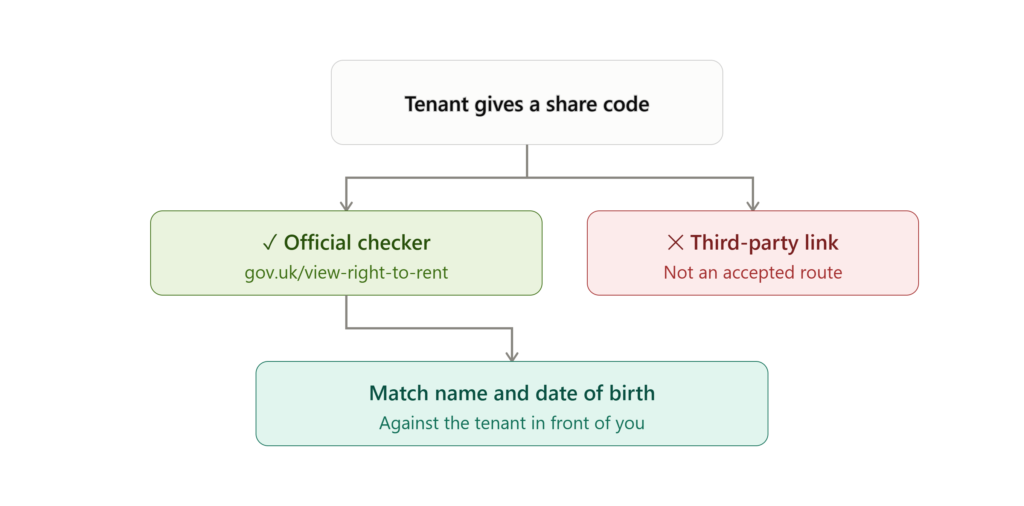
Tenants with an eVisa or other digital immigration status use the Home Office’s online service to generate a share code. The landlord enters this code on the official checking service, which confirms the tenant’s right to rent and any time limit on that right.
Identity Service Provider (IDSP) check
For British and Irish citizens holding a valid passport, landlords can use a certified Identity Service Provider to carry out the check digitally via facial recognition technology — an increasingly common route that avoids an in-person document check.
Record keeping
Whichever method is used, the landlord must keep a clear copy of the check (document copy, digital check confirmation, or IDSP report) along with the date the check was carried out, for the duration of the tenancy and for one year afterwards.
Timing matters: The check must be carried out before the tenancy starts — not after the tenant has already moved in. A check carried out retrospectively does not provide the landlord with the statutory defence against penalties.
Accepted documents
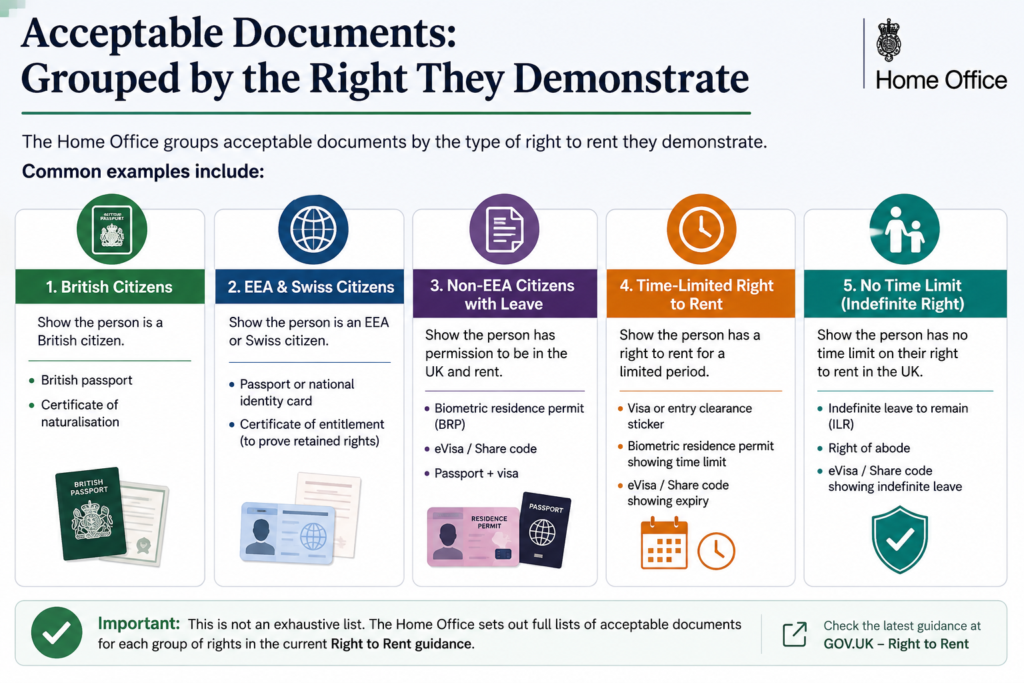
The Home Office groups acceptable documents by the type of right to rent they demonstrate. Common examples include:
Penalties for non-compliance
The financial and legal exposure for getting Right to Rent wrong is significant, and it scales with the severity and frequency of the breach:
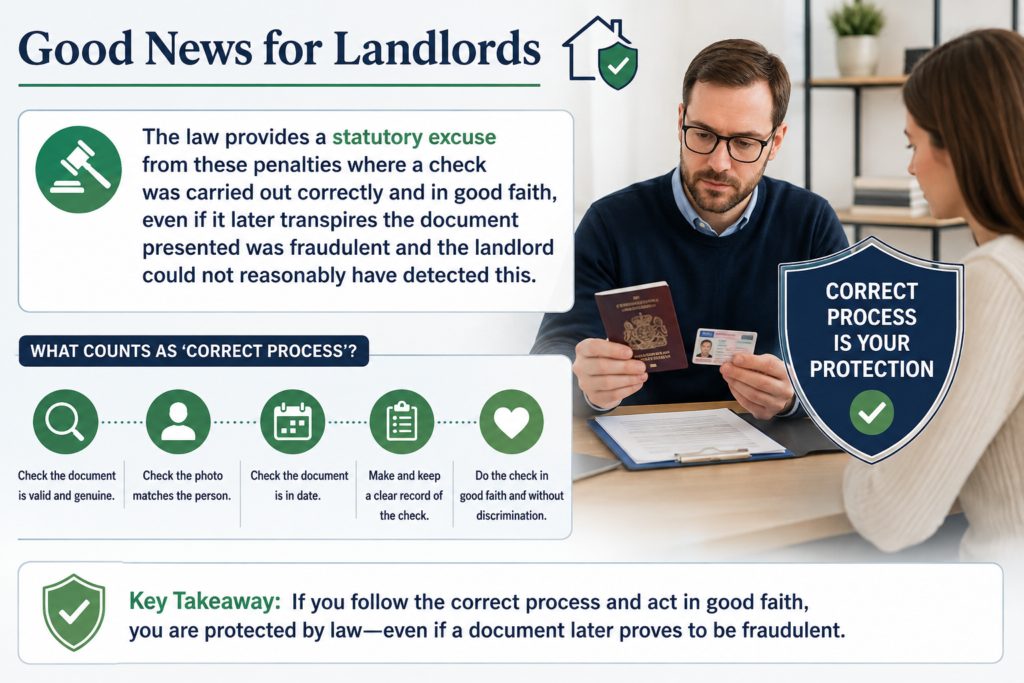
The good news for landlords is that the law provides a statutory excuse from these penalties where a check was carried out correctly and in good faith, even if it later transpires the document presented was fraudulent and the landlord could not reasonably have detected this. Correct process is, in effect, the landlord’s protection.
Follow-up checks for time-limited permission
Where a tenant’s right to rent is time-limited, the landlord has an ongoing obligation to carry out a follow-up check before the existing permission expires — typically the date shown on the eVisa, BRP, or digital share code result.
- Set a reminder well in advance of the expiry date — at least 28 days is good practice
- If the tenant’s status has been renewed, the follow-up check confirms continued right to rent and resets the next reminder date
- If a tenant’s right to rent has expired and not been renewed, the landlord must notify the Home Office and may need to take steps to end the tenancy in line with the relevant legal process
- Failing to carry out the follow-up check removes the landlord’s statutory excuse going forward, even if the original check was carried out correctly
Worth knowing: A landlord can instruct a letting agent in writing to carry out Right to Rent checks on their behalf. This doesn’t remove the landlord’s ultimate responsibility, but it can be a practical way to ensure checks are carried out consistently as part of the wider tenant referencing process.
Where to carry out the digital check
The official Home Office digital checking service is the only legitimate route for verifying a tenant’s status via a share code, and it should always be accessed directly through gov.uk rather than via a third-party link. Always verify the tenant’s name and date of birth shown in the result match the tenant in front of you before relying on the check.
Frequently asked questions
What is a Right to Rent check?
A Right to Rent check is a legal requirement for landlords in England to verify that a prospective tenant has the legal right to live in the UK before granting a tenancy. It involves checking original identity documents or using the Home Office digital checking service, and keeping a record of the check.
What happens if a landlord doesn’t do a Right to Rent check?
Landlords who fail to carry out a Right to Rent check, or who knowingly let to someone without the right to rent, can face a civil penalty of up to £20,000 per lodger or tenant for a first breach, rising to £40,000 for repeat breaches. In the most serious cases, landlords can face criminal prosecution with an unlimited fine and up to five years’ imprisonment.
Do landlords need to check Right to Rent for British citizens?
Yes. Right to Rent checks must be carried out for every adult tenant, regardless of nationality, including British and Irish citizens. A British passport or other accepted document is checked in the same way as for any other tenant — the requirement applies universally to avoid discrimination.
How long does a Right to Rent check last?
For tenants with an unlimited right to remain in the UK, the check does not need to be repeated. For tenants with time-limited permission to stay, the landlord must carry out a follow-up check before the existing permission expires, to confirm the right to rent continues.
Can letting agents do Right to Rent checks on behalf of landlords?
Yes. A landlord can instruct a letting agent in writing to carry out Right to Rent checks on their behalf. However, the landlord remains ultimately responsible for ensuring the check was carried out correctly and that adequate records were kept, even where an agent has been instructed.