Drone laws in London explained: Flyer ID, airspace, Royal Parks and permissions. Your essential guide to staying compliant on every listing shoot.
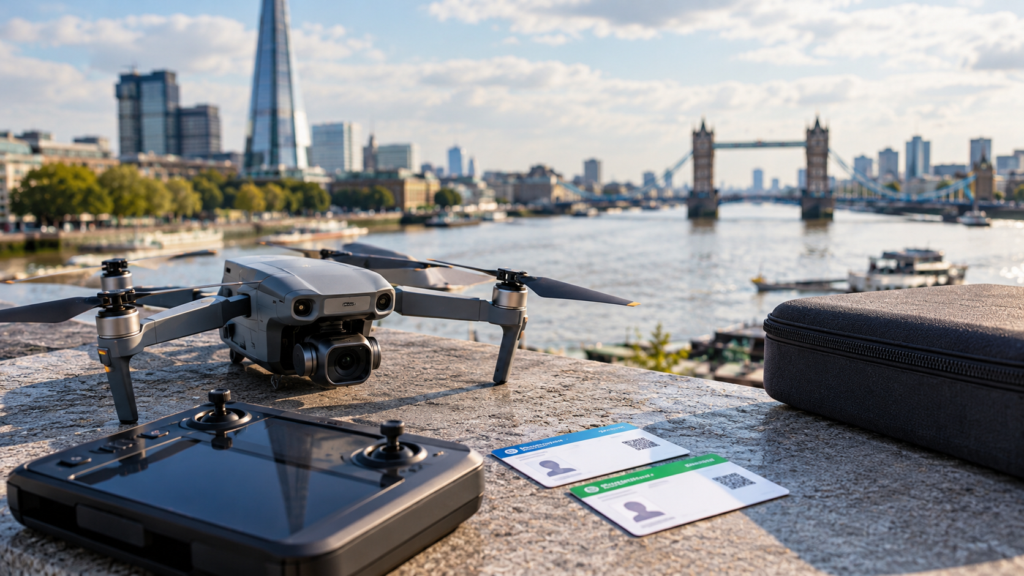
Drone laws in London are tougher than in most of the UK, and an agent who commissions aerial photography without understanding them risks a postponed shoot, unusable footage or an awkward complaint from a neighbour. This guide explains the rules that matter when you book a drone, what a compliant pilot should be able to show you, and the questions worth asking before the propellers start spinning.
What UK Drone Rules Require of a Pilot
Since 1 January 2026, anyone flying a drone weighing 100g or more must hold a Flyer ID, earned by passing the Civil Aviation Authority’s free online theory test. Whoever is responsible for the aircraft also needs an Operator ID if the drone carries a camera, which covers virtually every property-marketing aircraft. Think of the Flyer ID as the pilot’s personal credential and the Operator ID as the registration of the business behind the drone.
Those IDs are only the starting point for professional work. Most commercial pilots flying in built-up areas operate under one of two routes:
- Open category, A2 subcategory: the pilot holds an A2 Certificate of Competency, which allows certain lighter drones to be flown closer to people than the basic rules permit.
- Specific category: the operator holds an Operational Authorisation from the CAA, needed when a flight goes beyond the limits of the Open category.
Which route applies depends on the aircraft, the location and the risk assessment for the flight.
What to ask a drone operator to show you
A professional should be comfortable answering these questions without hesitation:
- Do you hold a current Operator ID, and is it displayed on the drone?
- Which Flyer ID and competency, such as an A2 CofC, does the pilot hold?
- Do you carry public liability insurance suitable for commercial drone work?
- Will you check airspace and landowner permissions before the shoot date?
Operator IDs are renewed annually, whereas Flyer IDs and the A2 CofC last five years, so it is reasonable to ask for evidence that each is still valid.
Drone Laws in London
Two separate layers of rules decide where a drone can fly: airspace restrictions and landowner permission.
Flight Restriction Zones around the airports
Large parts of the capital fall within controlled airspace because of Heathrow, London City and other nearby aerodromes. Inside a Flight Restriction Zone, a drone cannot take off or fly without permission from the aerodrome’s air traffic control. Permission is granted case by case, and the location and flight details must be supplied in advance. Two listings in the same borough can therefore face very different airspace conditions, so the exact postcode matters more than the area name.
Royal Parks, commons and council land
Landowners set their own rules, separately from airspace. The Royal Parks, including Hyde Park and Richmond Park, prohibit drone take-offs and landings, and many boroughs, commons and open spaces ban flying or require written consent. That matters because a flat overlooking a park cannot simply be filmed from the park. The pilot needs a legitimate launch point, such as the property’s own garden or a private forecourt, and permission from whoever controls it.
Flying near people, neighbours and privacy
A drone must be flown so that people and property are not endangered, and flights over crowds or busy streets are unlikely to be acceptable. Privacy is a separate issue. If footage identifies individuals, UK data protection rules can apply, so careful pilots frame shots to avoid neighbours’ windows and gardens and edit out recognisable people before publication. Every case differs, so treat this as general information rather than legal advice.
Four Compliance Mistakes Agents Make
Even experienced agents can misread drone laws in London in these four ways:
- Assuming the vendor can grant every permission. A freeholder or managing agent often controls the roof, communal gardens or forecourt of a flat, so their consent may be needed too.
- Booking too late. Airport permission and landowner consent take time, so a same-week request may not be realistic near an airport.
- Treating a small drone as a loophole. A lightweight camera drone of 100g or more still requires a Flyer ID for the pilot and registration for the operator.
- Relying on qualifications from abroad. UK and EU requirements are not interchangeable, so a qualification gained overseas should never be assumed to carry over.
Building Compliance Into Your Booking Timeline
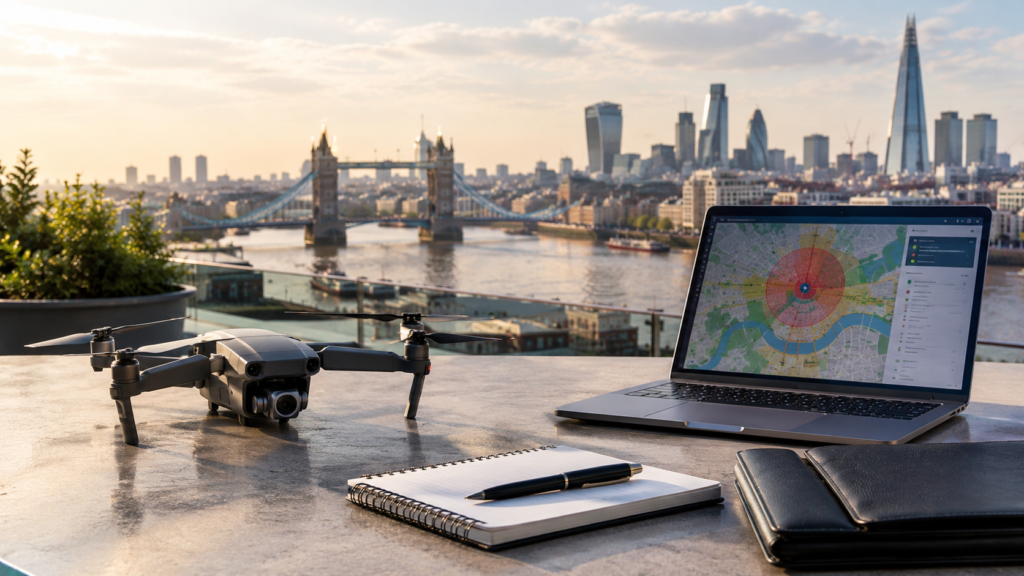
Drone laws in London reward early planning, so treat compliance as part of the instruction process rather than an afterthought. Confirm the address and any managing agent as soon as you win a listing, ask the operator to check airspace, and allow a buffer for permissions if the property is near an airport. If you would rather not coordinate this yourself, a CAA-licensed drone operator covering London can run the airspace checks and flag restrictions before the shoot is confirmed, leaving you free to concentrate on the vendor relationship.
Frequently Asked Questions
Do I need permission to fly a drone over a house I am marketing?
The pilot needs the landowner’s permission to take off and land, which usually means the vendor, landlord or managing agent. The bigger questions are safety, airspace and privacy rather than the property itself.
Can drones be flown in central London?
Sometimes, but rarely on a casual basis. Central areas combine controlled airspace, Flight Restriction Zones and strict landowner policies, so professional flights normally need advance planning and permission.
Does a lightweight drone avoid the rules?
No. Under drone laws in London and across the UK, registration and Flyer ID requirements now apply from 100g, and airspace, landowner and safety rules apply whatever the weight.
Conclusion
Compliance is what separates a smooth aerial shoot from a stalled one. Know which IDs your operator holds, check airspace and landowner consent early, and keep privacy in mind during editing. Understanding drone laws in London will protect your reputation as well as your vendors’ listings. Before your next instruction, read the CAA’s Drone and Model Aircraft Code and confirm current requirements directly, because the rules continue to evolve.